
What Makes Central Otago Pinot Noir Different?

The main divide of the Southern Alps separates New Zealand’s wettest region, the West Coast, from its driest, Central Otago. That is how the National Institute of Water and Atmospheric Research describes it in The Climate and Weather of Otago, and NIWA goes on to say that no part of New Zealand comes closer to a semi-arid continental climate, with hot, dry summers and cold, dry winters. For Pinot Noir, the result is a dry growing season, a wide swing between day and night temperatures, and free-draining soils over a bedrock of schist. The wine industry built on those conditions is young, with its first commercial release in 1987.
Where is Central Otago?
Central Otago is New Zealand’s southernmost wine region, set inland in the south of the South Island on the 45th parallel south. Central Otago Winegrowers, the regional association, describes its sub-regions as forming a broad triangle east of Queenstown, roughly 85 kilometres from north to south and 60 kilometres from east to west, with vineyards covering just over 2,000 hectares. Pinot Noir dominates. New Zealand Winegrowers’ regional factsheet puts it on more than 80 per cent of the region’s vineyards and ranks Central Otago as the country’s third largest wine region. The 2022 vineyard register, published in the Vineyard Report 2023, recorded 1,629 hectares of Pinot Noir out of 2,013 hectares in total.
Why is Central Otago so dry?
Air arriving off the Tasman Sea is forced up over the western ranges, where it cools and drops its moisture as rain, and by the time it moves east it carries far less. NIWA’s climate normals for 1981 to 2010 record annual rainfall of 363 millimetres at Alexandra, 416 at Clyde, and 437 at Cromwell, and in the driest parts of the region that is about a tenth of what falls on the high western ranges of Otago. Alexandra receives 36 per cent of its year’s rain in summer.
Afternoon humidity at Alexandra averages 46 per cent across the year, against 65 per cent at Dunedin on the coast, and NIWA records more than 2,000 hours of sunshine a year at many inland locations in Otago. In a 2008 analysis of New Zealand terroir, Stephen Imre and Jeffrey Mauk of the University of Auckland found water deficits in Central Otago high enough that irrigation is common, particularly on newly established sites.
Why does the day-night temperature range matter for Pinot Noir?
According to New Zealand Winegrowers, the nights in Central Otago stay cold even in the height of summer, and “this large diurnal range means the grapes retain all-important acidity and the resulting wines are precise and focussed.” Central Otago Winegrowers describes warm days that encourage ripening and cool nights that preserve “bright acidity, delicate aromatics, and vibrancy.”
At Alexandra, NIWA’s records put the day’s maximum and the night’s minimum an average of 13.4 °C apart in February, 13.3 °C in March, and 12.9 °C in April, the months leading up to and through harvest. The same months at Dunedin average 7.6 °C, 7.3 °C, and 7.3 °C. NIWA attributes the difference to the region’s inland location, which “isolates the area from the moderating influence of the sea on air temperatures.”
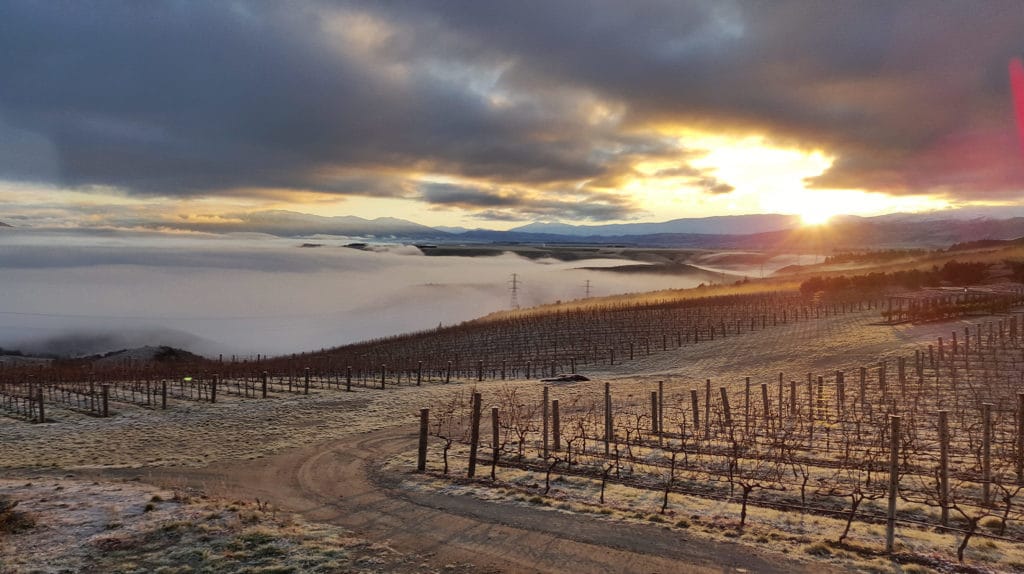
The same cold nights bring frost, which NIWA finds most likely on flat ground, where cold air cannot drain away on calm nights, and in valleys, where it pools after draining down from higher ground, and of the Otago locations NIWA tabulates, Alexandra records air frosts most often.
What soil is Central Otago Pinot Noir grown on?
Most of the region’s vines grow in soils laid over a bedrock of Otago Schist: river silts and gravels, glacial material, and wind-blown loess. Writing from the region in 2019, Jamie Goode observed that while the parent bedrock is schist, “most of the soils are things that have come from elsewhere and then been deposited,” moved about by the rise and fall of water during the ice age. Those changing water levels left a series of terraces of different ages, the highest of them the oldest. Because so little rain falls, there has been little plant growth, and organic matter in the soil is very low. The same dryness has produced pedogenic lime, of which Goode found “a fair bit” in the region. New Zealand Winegrowers notes that soils vary considerably within each sub-region, “though a stony free-draining base is common to all.”
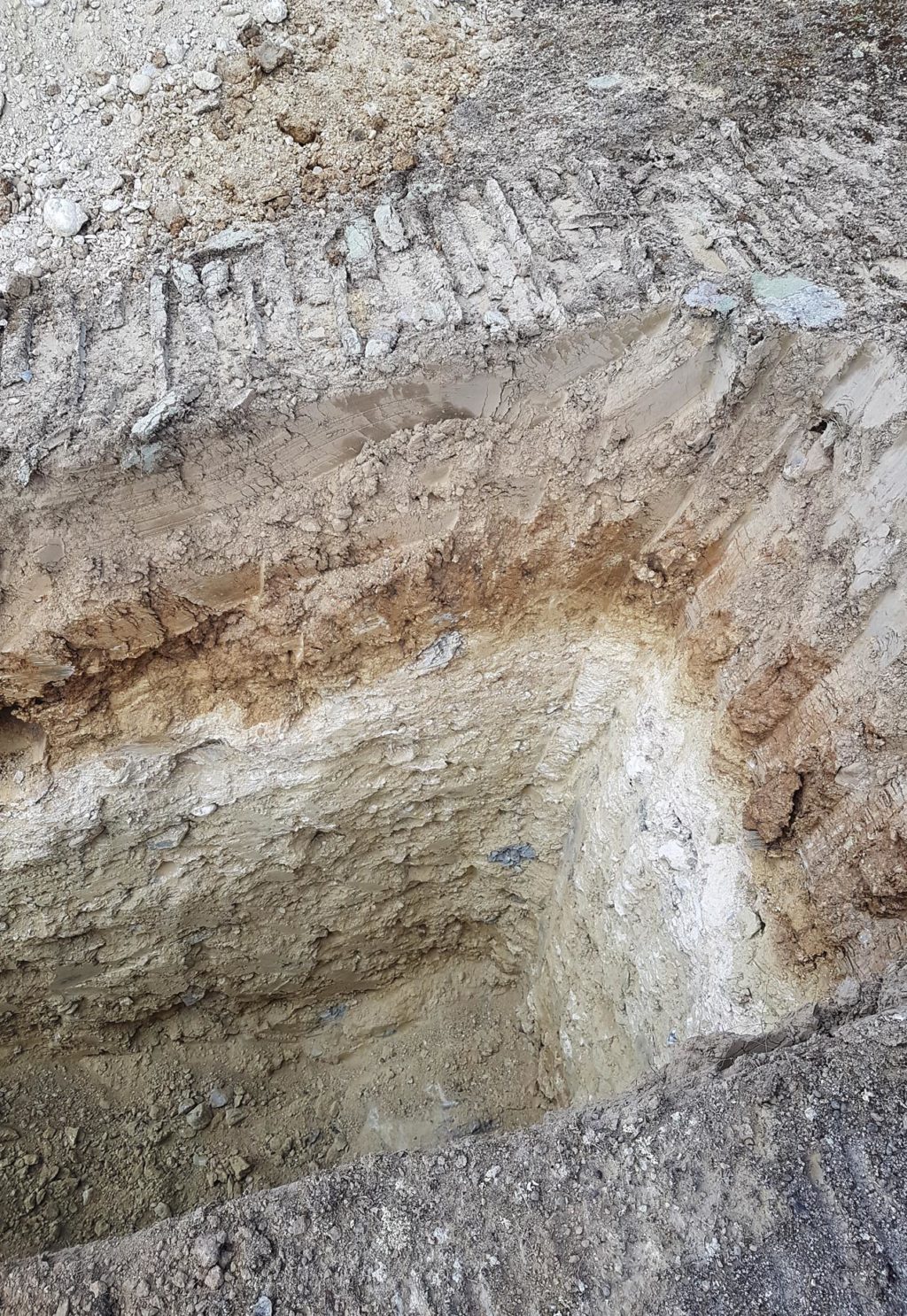
According to a 2016 field guide from the Geoscience Society of New Zealand, the schist began as greywackes and argillites deposited in Permian and Triassic times in ocean basins and trenches off Gondwana, and was metamorphosed into Otago Schist during the Jurassic. By about 110 million years ago it had been uplifted and eroded to a low, level surface. About 15 million years ago, after the boundary between the Australian and Pacific plates had developed through New Zealand, the landscape began to change, and tectonic uplift eventually filled an ancient lake with gravels. In their 2008 analysis, based on the vineyard database in early 2007, Imre and Mauk found Central Otago to be the only place in New Zealand where schist underlay vineyards, with 49 per cent of the region’s plantings on schist and 44 per cent on gravels.
When did winemaking begin in Central Otago?
Vines were first planted in Central Otago in the 1860s, around Clyde and Alexandra, and Central Otago Winegrowers’ history of the region credits the Frenchman Jean Désiré Féraud with what is widely considered its first wine. Those early efforts struggled against the extreme climate and the distance from markets, and by the middle of the twentieth century viticulture had nearly disappeared. A small group of growers began experimenting again in the 1970s and 1980s, among them Ann Pinckney, Verdun Burgess, Sue Edwards, Rolfe and Lois Mills, Alan Brady, and Bill and Sue Grant. Jamie Goode describes Gibbston Valley’s 1987 release as the first commercial wine from Central Otago, and Central Otago Winegrowers records it as the first commercial Pinot Noir.
Winemakers at a tasting of older vintages hosted by Prophet’s Rock, as Elaine Chukan Brown reported in January 2017, credited the vineyards planted in the Cromwell Basin with securing the region’s future, and the basin still holds the highest concentration of vines. At a 2017 masterclass, the winemaker Grant Taylor put the average age of a Central Otago vine at around ten or eleven years. Matt Dicey of Mount Difficulty has described Pinot Noir taking a leap in quality once vines reach about ten years of age, and another at eighteen to twenty, as reported on Jamie Goode’s wineanorak site in 2014.
How has the style of Central Otago Pinot Noir changed?
Central Otago Pinot Noir has moved from ripe, fruit-forward wines towards lighter, fresher ones, picked earlier and handled less in the winery. The winemakers at that 2017 tasting singled out one season, 2002, as the turning point towards the riper style. Before 2002, they told Chukan Brown, growers were used to austere fruit and struggled to get extraction in the cellar or weight from the vines. The hot 2002 vintage, on young vines, then produced exuberant, ripe, fruit-forward wines, and drew attention to the region at a time when people wanted big wines. The warm 2006 vintage led many to make bigger wines with more rusticity, and the experience turned interest towards cleaner wines and more finesse.
Chukan Brown, writing in 2018, counted earlier picking as one part of the change and found that “the more significant difference has come from reducing handling in the cellar.” Blair Walter of Felton Road summed up the winery side for The Drinks Business in 2019: “Earlier picking, less extraction from reduced punchdowns and more moderate use of new oak is leading to more harmonious, site expressive wines.” Prophet’s Rock winemaker Paul Pujol, who chaired the 2019 Central Otago Pinot Celebration, told the conference:
“The older style of Central Otago Pinot was more opulent and powerful with higher alcohol. The wines we’re making are lighter in alcohol now. It feels right to pick earlier and capture a brightness and energy in the wines.”
Paul Pujol
After the 2017 masterclass, Goode credited vine age, writing that “the wines used to taste more similar than they do now, and vine age seems to be helping produce more structured wines that have some non-fruit complexity as well as the delicious sweet fruit that Central delivers so consistently.” In the same session, Walter said that as his vines aged he had to acidify far less, and that his wines often came in lower in alcohol.
What are the sub-regions of Central Otago?
New Zealand Winegrowers names six sub-regions: Gibbston, Bannockburn, Cromwell, Lowburn and Pisa as a single group, Bendigo, Wānaka, and Alexandra. Central Otago Winegrowers lists eleven, treating Cromwell, Lowburn, and Pisa separately and adding Northburn, Queensberry, and Tarras. Bannockburn is registered as a geographical indication in its own right, on the IPONZ register since 1 February 2022.
Gibbston, rising through the Kawarau Gorge, is the highest and coolest of them, and its vines ripen later than those of its neighbours. Harvest in Bannockburn can come up to a month ahead of Gibbston’s. At the 2017 masterclass, Grant Taylor put Gibbston’s growing degree days at 20 per cent below Bendigo’s, and Goode found the warmer Bendigo wine carrying more tannin in its structure, where the Gibbston wine drew its structure from tannin and acidity together.
Bendigo lies on the eastern shore of Lake Dunstan, north-east of Cromwell, and Tom Cannavan describes it as one of the warmest and most widely planted of the sub-regions, on rocky soils. New Zealand Winegrowers places its vines on gentle north-facing slopes and stony soils. West of the lake, in the area New Zealand Winegrowers groups as Cromwell, Lowburn, and Pisa, most plantings sit on the lower terraces and valley floor running parallel to the Pisa Range.
New Zealand Winegrowers calls the sub-regions very distinctive. In the 2017 masterclass discussion that Goode reported, the view was that as vines age the sub-regional differences “so evident in young vine Pinot” become less clear, and site and soil type matter more. Andy Crozier of Burn Cottage, speaking in 2019, called the sub-regions “the next story that we need to tell in Central Otago,” and added that “we’re learning what works where.”
How much of Central Otago is farmed organically?
Nearly a third of Central Otago’s vineyard area is certified organic. Central Otago Winegrowers reported 30 per cent in February 2025, the highest proportion of any New Zealand region. The dry climate helps: Elaine Chukan Brown wrote in 2020 that “its dry climate means greatly reduced disease pressure,” and NZ Winegrower reported in 2019 that dry autumns and relatively low humidity can reduce the need for chemical sprays. At Prophet’s Rock, the Home Vineyard completed full BioGro organic certification before the 2018 vintage.
How well does Central Otago Pinot Noir age?
Jasper Morris MW told the 2019 Central Otago Pinot Celebration that the region “is making Pinots capable of ageing for much longer now,” and tied the change to the vines: “The wines used to fade fast, which had a lot to do with the young age of the vines. It’s much less the case now.” Emma Jenkins MW, at the same event, described “Pinots with the potential to age and turn into something even more interesting, rather than simply getting older.”
Those judgements rest on a short record. Blair Walter told Joelle Thomson in 2026 that “there are no decades of history to witness vintages dating back to the 1960s and 1970s, let alone earlier,” and he attributes the relatively rapid ageing of many 1990s wines mostly to young vineyards.
How do Prophet’s Rock’s single-vineyard Pinot Noirs differ?
Four of Prophet’s Rock’s single-vineyard Pinot Noirs come from two sub-regions: the Home Vineyard Pinot Noir, the Cuvée Aux Antipodes Pinot Noir, and the Olearia in Bendigo, and the Sophora in Pisa. For all four, the team hand-picks the fruit, destems it, and ferments it with indigenous wild yeast in small open-top tanks, plunging each by hand only once over the whole fermentation, and manages yields at 30 to 35 hectolitres per hectare. In 2024, the vintage of the current Home Vineyard, Olearia, and Sophora releases, winter ended mild and spring was stable, with no frost. January and February were warm and very dry until the weather cooled in late February, March was mild, with only five days reaching 25 °C, and settled weather from mid-March to the end of harvest in April let the team pick on flavour and ripeness. Thirty-three barrels of the Home Vineyard were made that year, and twenty-four each of the Olearia and the Sophora.
The Home Vineyard sits on a steep glacial terrace at 320 to 390 metres, high above the Bendigo valley floor. The terrace formed about 650,000 years ago and holds some of the oldest vineyard soils in the valley. Their age and the dry climate have produced an unusual structure of clay and pedogenic lime, with a thick layer of chalk beneath the clay at 50 to 80 centimetres. Tasting the 2010, Jamie Goode described “a lens of chalk, which is actually pedogenic lime, with minerals in the rain accumulated in the soil by evaporation.” The 7.5-hectare site, planted between 1999 and 2001, includes seven clones of Pinot Noir, and the wine has come only from this vineyard since its first release in 2005. The 2024 carries the chalky mouthfeel typical of the site through a long, textured finish.
The Cuvée Aux Antipodes Pinot Noir, made in collaboration with François Millet of Chambolle-Musigny, comes from a single parcel of the same vineyard: one clone at the western end of the terrace’s steep front face, the source of every vintage since the first release in 2015. Thirteen barrels of the current release, the 2023, were made, at 12.5 per cent alcohol. The Wine Advocate’s Erin Larkin scored the 2022 97 points and found it “tightly wound and floral, with violets, crushed rocks, tapenade, apple skins, blood orange and black tea.”
Rocky Point, at the southern end of Bendigo, has some of the steepest planted blocks in Central Otago, and the site rises from 226 to 351 metres with Lake Dunstan below. The Olearia comes from its highest parcels. The soil is schist in varying degrees of decomposition, from solid slabs to pockets of fine clay, and the site has very low vigour, and small yields are the norm. At 13.0 per cent alcohol, the 2024 has a linear, ethereal structure and a graphite, almost saline finish.
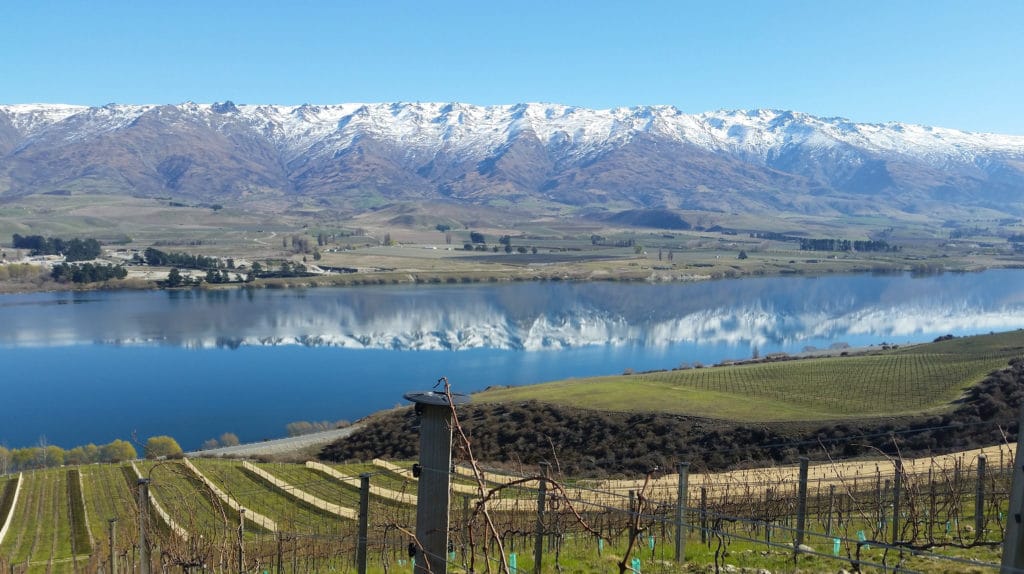
Kopuwai Delta, the source of the Sophora, lies at 225 metres on a high terrace overlooking the Clutha River where it runs into Lake Dunstan, at a narrow point in the valley between the Pisa and Bendigo ranges. Its free-draining soils are very fine and schist-based, with loess, alluvium, quartz, and rounded river stones. The 2024 has an open, perfumed nose of raspberry, red cherry, and rose.
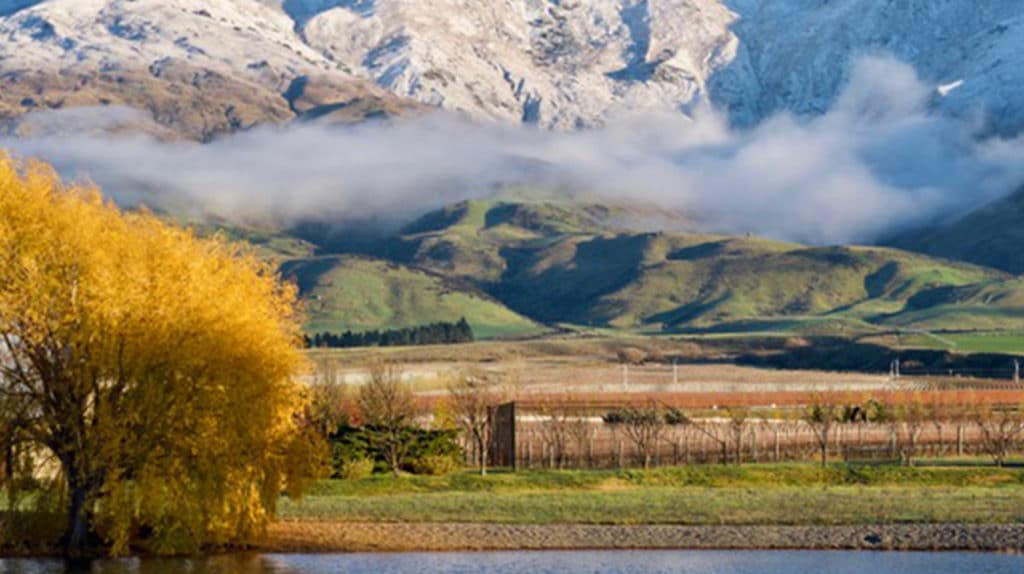
For the Home Vineyard, the critics’ record runs back to the first release: 97 Points, James Suckling, 2023; 97 Points, Bob Campbell MW, 2021, a wine he found “clearly from a favourable vintage and with obvious cellaring potential”; and 95 Points, Bob Campbell MW, 2005.
Frequently asked questions
Why does Pinot Noir grow so well in Central Otago?
Central Otago has the closest approach to a continental climate in New Zealand, dry and sheltered from westerly rain by the Southern Alps. Its nights stay cold even in summer, which New Zealand Winegrowers credits with helping the grapes keep their acidity, and at Alexandra the average gap between day and night temperatures is about 13 °C in the months around harvest.
Is Central Otago the southernmost wine region in the world?
Central Otago is New Zealand’s southernmost wine region. New Zealand Winegrowers describes it as one of the world’s most southerly wine regions.
How much Pinot Noir is grown in Central Otago?
Pinot Noir covers more than 80 per cent of Central Otago’s vineyards, according to New Zealand Winegrowers. The 2022 vineyard register recorded 1,629 hectares of Pinot Noir out of 2,013 hectares in the region.
What soil is Central Otago Pinot Noir grown on?
Most vineyards grow in soils laid over Otago Schist bedrock: river silts and gravels, glacial material, and wind-blown loess. The soils drain freely, are very low in organic matter, and in places contain pedogenic lime.
What are the sub-regions of Central Otago?
New Zealand Winegrowers names six: Gibbston, Bannockburn, Cromwell, Lowburn and Pisa, Bendigo, Wānaka, and Alexandra. Central Otago Winegrowers lists eleven, adding Northburn, Queensberry, and Tarras and treating Cromwell, Lowburn, and Pisa separately. Bannockburn is registered as a geographical indication.
When was the first commercial Central Otago wine released?
Jamie Goode describes Gibbston Valley’s 1987 release as the first commercial wine from Central Otago, and Central Otago Winegrowers records it as the first commercial Pinot Noir. Vines were first planted in the region in the 1860s.
How much of Central Otago is organic?
Central Otago Winegrowers reported in February 2025 that 30 per cent of the region’s vineyard area is certified organic, the highest proportion of any New Zealand region.
Can Central Otago Pinot Noir be cellared?
The record is short, because the vineyards are young. Blair Walter of Felton Road attributes the quick ageing of many 1990s wines mainly to young vineyards, and Jasper Morris MW said in 2019 that the region is now making Pinots capable of ageing for much longer.
Sources
- G. R. Macara, The Climate and Weather of Otago, 2nd edition, NIWA Science and Technology Series No. 67, 2015.
- New Zealand Winegrowers: Central Otago regional page; Central Otago factsheet (2025); Vineyard Report 2023.
- Central Otago Winegrowers: Central Otago, Subregions, History, and Pinot Noir pages; press release, 10 February 2025.
- Stephen P. Imre and Jeffrey L. Mauk, “A GIS Analysis of New Zealand Terroir”, VIIth International Terroir Congress, 2008.
- D. E. Lee and others, Paleobotany and sedimentology of Central Otago and Southland, Geoscience Society of New Zealand Miscellaneous Publication 145B, 2016.
- Jamie Goode, wineanorak.com: “Central Otago Pinot Noir masterclass, focusing on structure”, 23 January 2017; “Back in Central Otago”, 20 January 2019; “Central Otago (7) tasting verticals with Gibbston Valley”, 31 January 2019.
- wineanorak.com, “Central Otago Pinot Noir Masterclass looking at the 2012 vintage”, Central Otago Pinot Noir Celebration 2014 (undated, no byline).
- Elaine Chukan Brown, wakawakawinereviews.com: “Vintage Variation and the History of Central Otago Pinot Noir”, 25 January 2017; “Reducing Extraction in Pinot Noir”, 2 May 2018; “A Few Days in Central Otago”, 6 February 2020.
- Lucy Shaw, The Drinks Business: “Central Otago making ‘some of the best wines anywhere'”, 4 March 2019; “In focus: New Zealand Pinot Noir”, 23 August 2019.
- Jean Grierson, “Organic winegrowing in Central Otago”, NZ Winegrower, 14 November 2019.
- Tom Cannavan, “New Zealand 2020: part II, Central Otago”, wine-pages.com, 29 May 2020.
- Joelle Thomson, “Looking Back At Kiwi Pinot Noir”, timatkin.com, 18 February 2026.
- Intellectual Property Office of New Zealand, Geographical Indications Register: Bannockburn.
- Prophet’s Rock product pages: Home Vineyard, Olearia, and Sophora Pinot Noir 2024; Cuvée Aux Antipodes Pinot Noir 2023.